The Spinone Italiano is an ancient breed. They are considered versatile gun dogs and are adept at hunting, pointing, and retrieving, but their intelligence and temperament enable them to do just about anything, from acting as therapy dogs to hanging out on the couch with their family. Spinoni are gentle and sweet with children and are recognized for their loyalty, friendliness, sensitivity, and responsive nature. They were recognized by the AKC in 2000.
Percival was our third Spinone puppy. Our first, Fermat (b. February 23, 1998, d. November 12, 2008), was a beautiful orange roan with a noble disposition; we lost him to hemangiosarcoma, an especially horrible cancer that appears literally overnight: in Fermat’s case, early May 2008. Our second Spinone, Nocci (b. March 15, 2004), is also male but brown roan. He is sweet-natured and excepting one bout of Lyme disease is healthy to date. Both Fermat and Nocci came from Virginia, from one of the original breeders for Spinoni in the US.
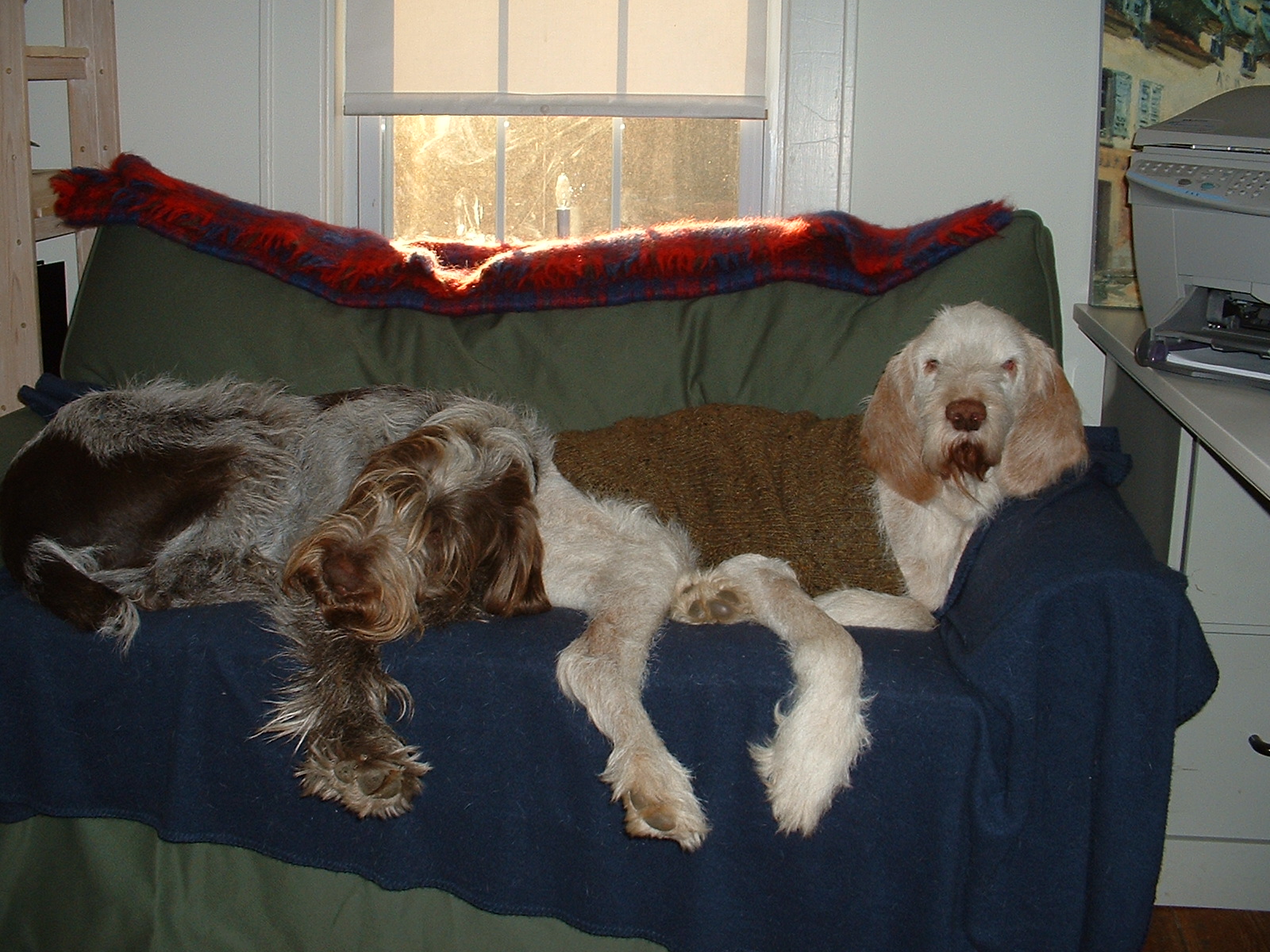
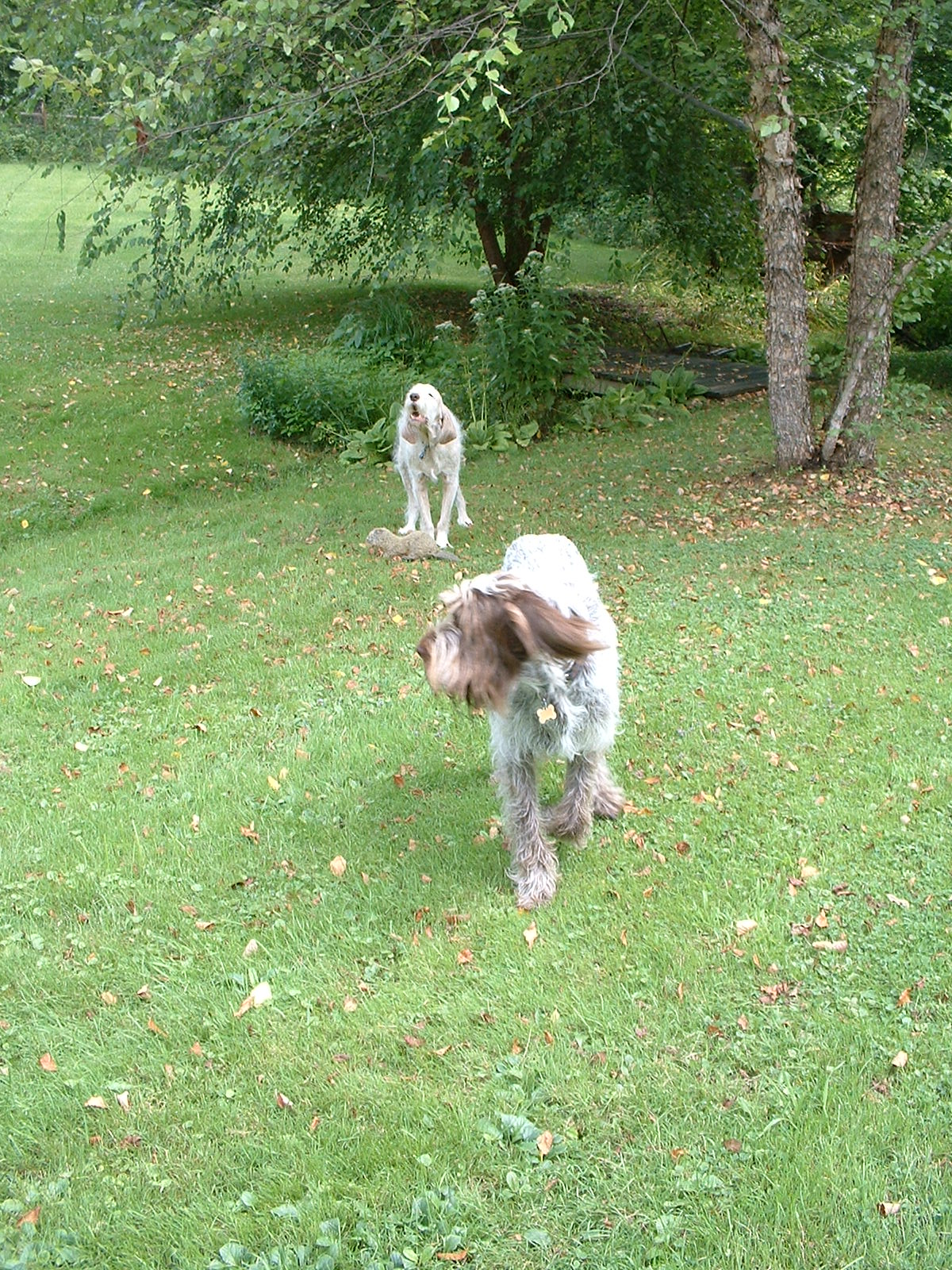
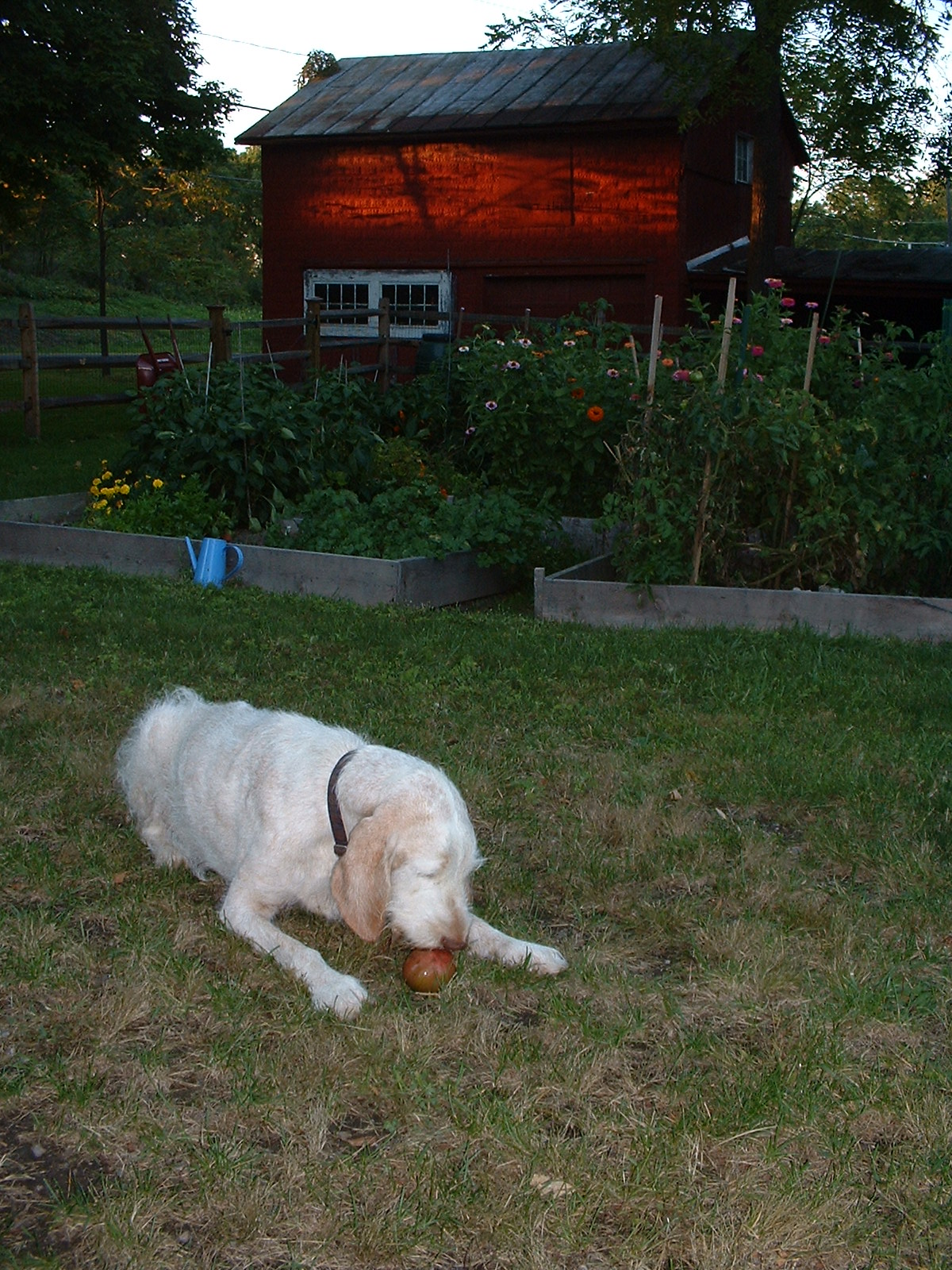
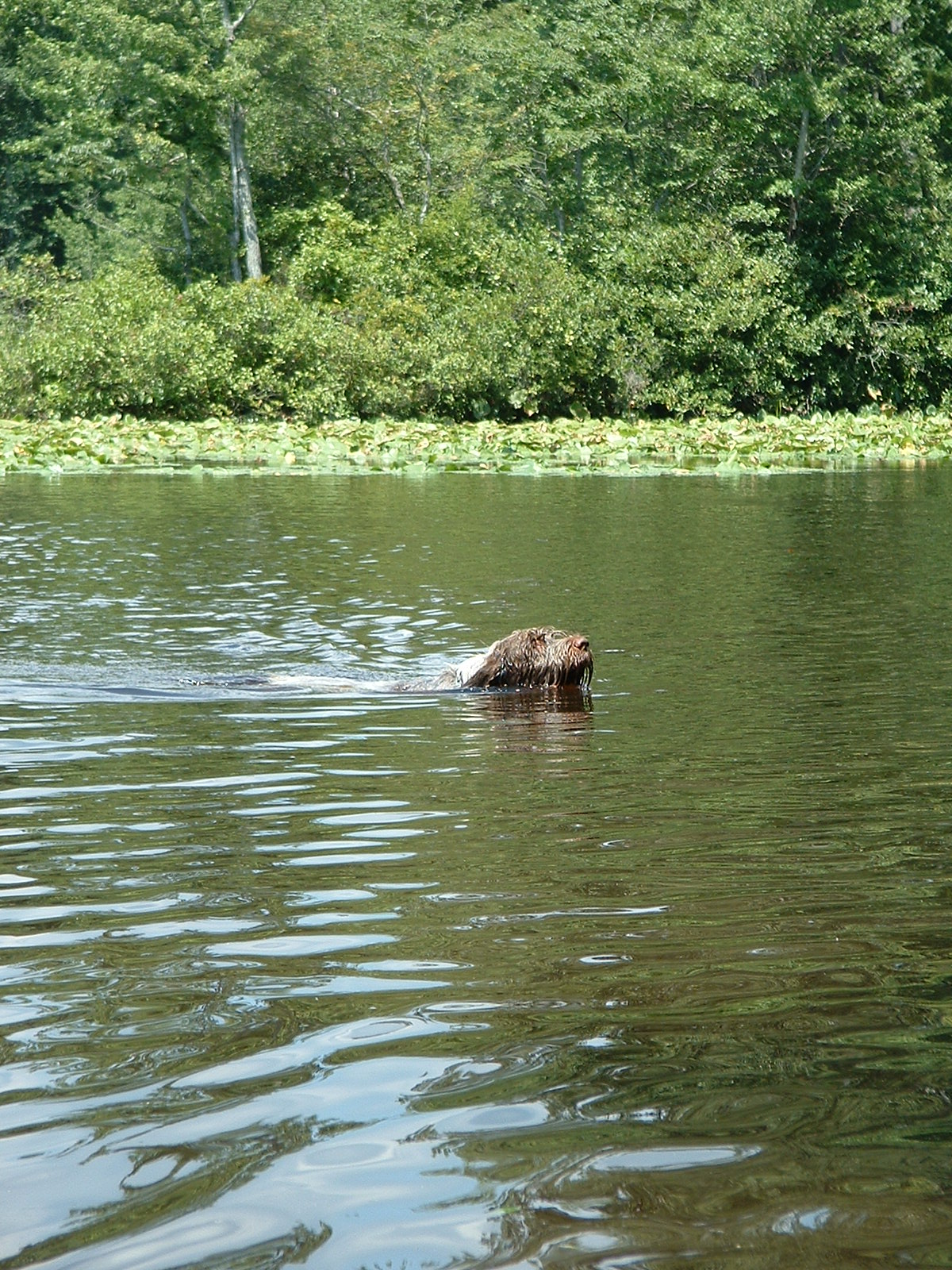
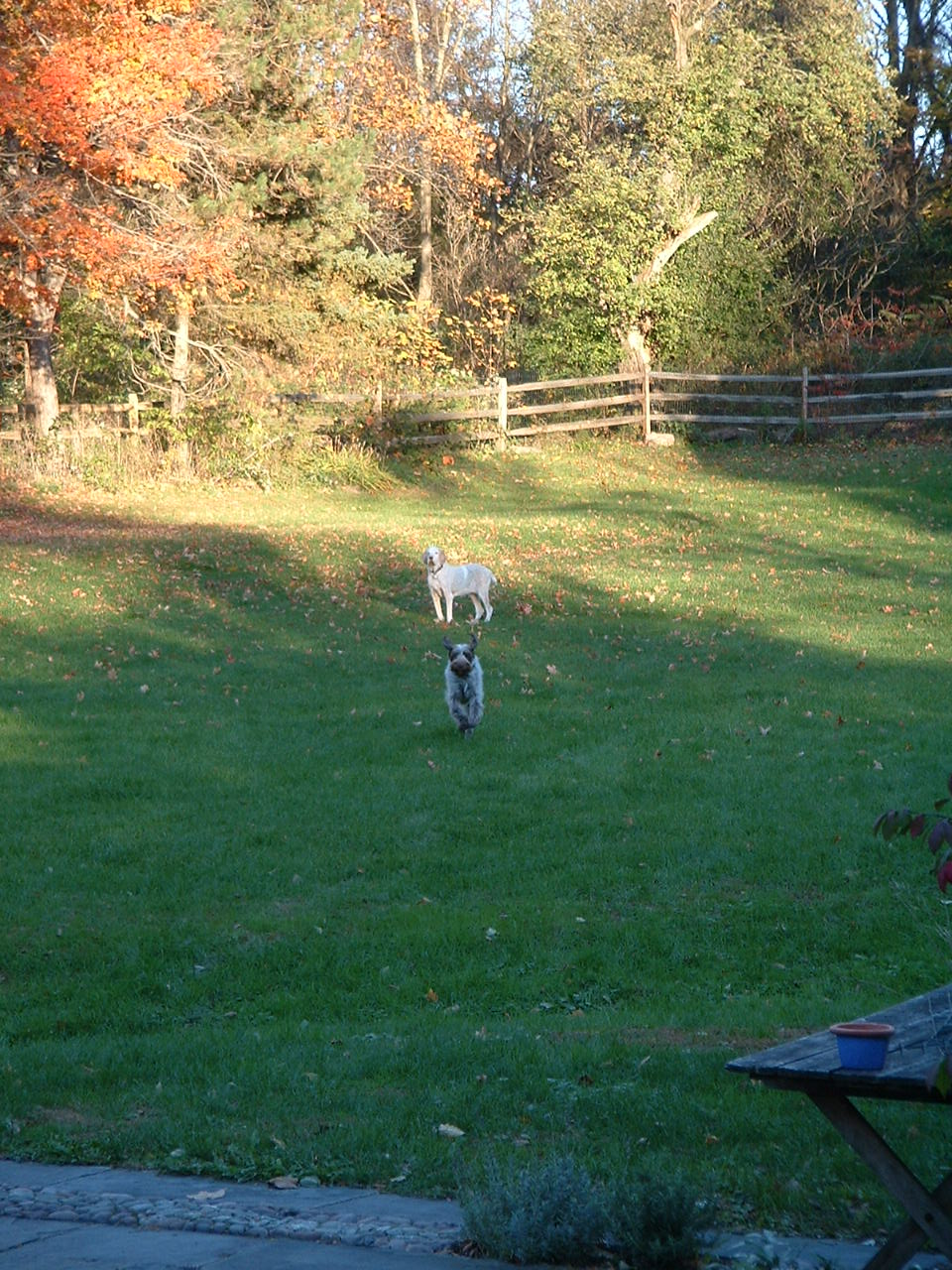
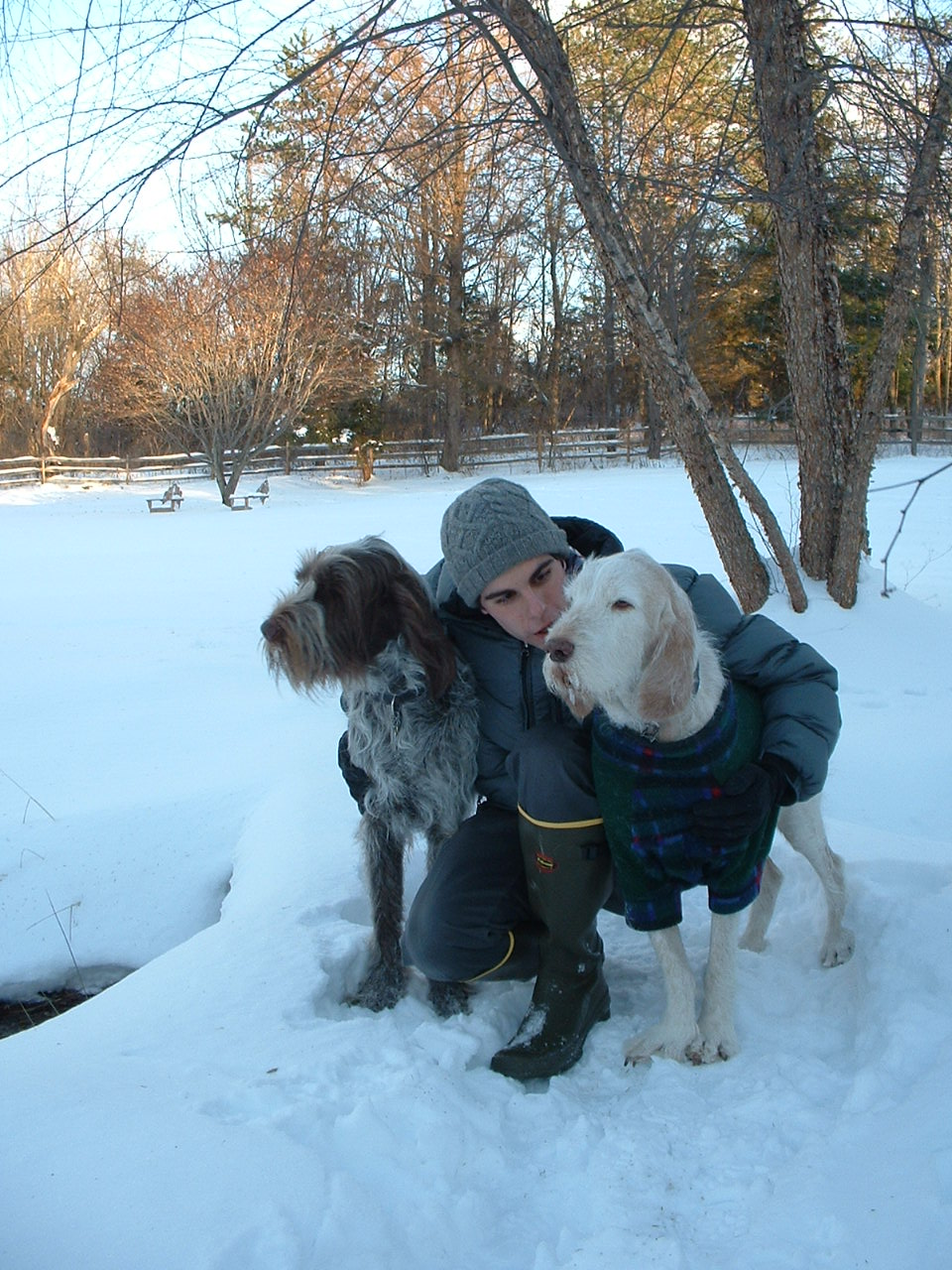
Percy was born May 31, 2009, male, orange roan, one of 11 pups in his litter in New York’s beautiful Adirondack Mountains, several hours north of us.
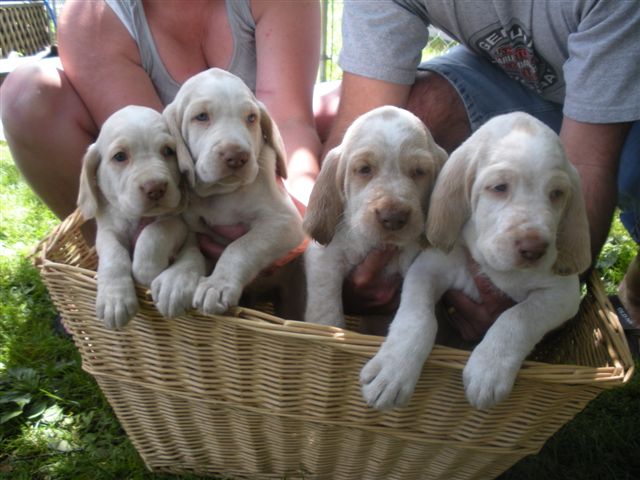
Percy (first on left) at 5 weeks
He, like Fermat and Nocci, was the runt of the litter but of course appeared healthy in every way. I brought him home July 25, 2009, age 7 weeks 6 days. He took to exploring our fenced acre and behaving as young puppies do; the only thing that may have seemed a little out of the ordinary was how especially intrepid he seemed: a pup on a mission. In retrospect, this seems a bittersweet comment on how short his time on earth would be.
Spinoni are a healthy breed as far as purebreds go. The only widely recognized genetic concern at present is cerebellar ataxia, a neurological disorder carried as a recessive trait that if it does appear fatally affects young puppies within weeks or months of birth through a loss of motor coordination. Careful conscientious breeding has controlled its spread. See http://www.aht.org.uk/genetics_spinone.html for more information on CA.
In addition, my own research found that in the UK, where Spinoni are more numerous than in the US and thus more data exists, epilepsy has been seen to occur in the breed at a higher frequency, something no one associated with the breed in this country was aware of. See http://www.veterinary-neurologist.co.uk/seizures_epilepsy.htm for background.
Thus, when Percy’s first symptoms appeared, it struck out of the blue. And because the symptoms of JRD can be mistaken for other ailments like leptospirosis or even Lyme, it is quite likely that many dogs are misdiagnosed. Percy was especially young when his symptoms appeared, but most dogs suffering from JRD will show symptoms before two years of age. However it is possible that dogs will show symptoms even later than that, and also possible that they carry the trait and not show any symptoms. Whatever the age symptoms appear, the prognosis is not good. For Percy, I hoped to get him past a year, but we did not make it. He died April 15, 2010.
The Disease
Juvenile renal dysplasia is characterized by abnormal cellular differentiation of renal tissue. Affected dogs are born with underdeveloped kidneys– there is an embryonic arrest in their development. The immature nephrons normally found in young puppies persist throughout life, with some undeveloped nephron units replaced by fibrous tissue .
Here is the simplest, best short description I’ve found to date for the layman on how this disease may be transmitted, from the Bernese Mountain Dog site :
“RD is believed to be caused by a simple autosomal recessive gene, i.e. both parents have to be carriers for a puppy to become sick. Statistically, 25% of the puppies from such a combination should become ill, 50% should be carriers, and 25% should be neither carriers nor affected. Unfortunately, Mother Nature is not that predictable and sometimes, many pups can become ill, and at other times, perhaps none at all. In addition, mildly affected dogs might die from other causes, like cancer, before they are diagnosed with RD, or very severe cases die as neonates and are never investigated by the breeder. Then there is no way of knowing that the parents actually carry this fatal disease or that their puppies may be carriers who will continue to pass the disease on. This is how disease genes can spread ‘quietly’ through a population before anybody realizes that there is a problem.” http://www.bmdca.org/health/Miscellaneous/Renal_Dysplasia.php
That is the problem in a nutshell: people might expect that if the disease is genetic it would appear in multiples, if not within a given litter then in separate litters from the same dam, for example. But indeed, Mother Nature trumps statistics here. A dog could be a carrier yet appear clinically normal, never becoming ill; a dog who might only begin to show symptoms at age 2 could be misdiagnosed with another kidney-affecting or even other disease; a dog who might somehow make it to 4 years with JRD could die of another cause earlier and never have shown symptoms. A dog will most often not become symptomatic until kidney function is less than 25%.
Whatever the breed, if you have a dog with kidney disease please write and share your story. At what age did you see onset of symptoms, and what were they? What kind of care is your dog getting– traditional, holistic, combination? Have you been in contact with the breeder? Are there other known cases? The more information we can share the better, as it is silence which allows genetic diseases to spread.
From the AKC site:
“Moderately affected puppies may appear normal until five or six months of age and then follow the same course, with chronic debilitation and death at nine to twelve months. Many animals with the disease, however, are only slightly affected and will live a normal life with normal renal function. Nevertheless, they can pass on some degree of the defect to their offspring.” http://clubs.akc.org/astc/health/astchlth/genemap/
From a 1989 article in the Journal of Small Animal Practice (see links), over two decades ago–thus, this is nothing new:
“Juvenile renal disease in dogs has been encountered in over 20 breeds but in only nine of these (cocker spaniel, Norwegian elkhound, lhasa apso, shih tzu, samoyed, dobermann, standard poodle, soft-coated wheaten terrier and bull terrier) have familial nephropathies been reported, and in only two (samoyed and cocker spaniel) has the exact mode of inheritance been elucidated. Reasons for this unsatisfactory state of affairs are:
1 Renal failure in young dogs may not be due to a familial nephropathy, and while helpful diagnostic information may be gained from blood and urine analysis, accurate diagnosis of the specific type of renal disease requires examination of renal biopsy or post mortem material by an experienced pathologist.
2 Not all affected animals show clinical signs at the same age, making collection of data, often from widely dispersed animals, both difficult and slow.
3 The disease process in one breed may be very different from that in another, so that each breed has to be investigated separately.
4 There has to be a willing determination to face the problem by individual breed clubs, with the commitment of a large number of breeders, owners and veterinary surgeons.
Resistance or inertia at any level will prevent or delay successful investigation and possible prevention of the disease.”
We’d love to hear from you if you have any comments!
I want to thank you for a very informative Web site and extend my heartfelt sympathies about the loss of your beautiful dog at such a young age. Percy was very lucky to have such a caring guardian who did so much for him and he clearly knew love for the short time that he was here.
Our dog died of JRD a few weeks ago (we had him euthanized but he only had days left and we did not want him to suffer). He was a rescue dog who was a mix of breeds–he weighed about 110 lbs and was very tall. He looked like part great dane, part black and tan coonhound, part lab. He was a gentle giant and the most amazing dog that I have ever had or ever will have.
When we adopted our dog at 1 year old, we were told that he liked to drink lots of water. We didn’t think much of it because the weather was warm there and he was a big dog. He never had accidents in the house.
We noticed he had a lot of tartar on his teeth and we were going to get a teeth cleaning at age 3. We did preanesthesia bloodwork and his BUN and creatinine were abnormal (kidney failure). Our vet asked whether it was possible he was older than we thought, but it wasn’t, because we had traced back his age by a coincidence (we found out someone we knew had known his first guardian, who had died), and it was clear he was still young from other health markers and his activity level, etc.
The vet, who is an excellent diagnostician, also considered leptospirosis (he had actually had a mouse in his mouth before that, but he was vaccinated against lepto). however, his lepto titers were normal.
Then we took him to the internal medicine specialist, where he had an ultrasound. His kidneys were clearly underformed and he was diagnosed with renal dysplasia.
About a year later, he was sick with what seemed like a flu–vomiting, low energy, etc. We had his kidney values checked and he was in stage 3 kidney failure. By now he was 4 years old.
We fed him a kidney diet and had his kidney values checked very few months. A year later, at about age 5, we found out he had entered stage 4 renal failure, and literally within days he began vomiting quite a bit and declined with every passing day. We gave him sub-q fluids but to no avail (he was so large, that may have been an issue).
The vet said we could take him to the specialist to stay for a few days and get IV fluids but there was a chance it wouldn’t help and if it did, it would only give him a couple of weeks at best, with a low quality of life. We decided to keep him comfortable at home instead. He was comfortable on the couch surrounded by his family and I just couldn’t take him to a vet he didn’t know to be there day and night for 3 days just for a couple more weeks (possibly), knowing that dogs live in the moment. He received anti-nausea injections, which helped enough for him to eat some of his favorite foods.
Then one night (less than a week after we found out he was in stage 4 kidney failure), he started to become restless, kept wanting to go outside (I slept with him during this time), and ultimately in the morning vomited some yellowish liquid like bile. He also was drooling excessively with nausea for the last day or so.
He still remained our wonderful boy during this time, wagging his tail when he saw us and being so sweet. He always had the most amazing heart and personality. After the night when I knew that he had begun to feel discomfort, we called the vet and made an appointment to have him euthanized. When he became ill, he looked at me as if to say “please do something to help me.” I felt that was all I could do, to give him that final gift to end his suffering. By the time we got to the vet, his breathing was labored-almost the sound that someone makes when they are snoring. He was euthanized by our compassionate and amazing vet, who told us that we were doing the right thing, and he died peacefully.
I can’t quit crying and miss his so much. I feel like he had so much life left in him but his kidneys just couldn’t keep up with his spirit. I am so very sorry that you lost your sweet boy at such a young age. Thank you for doing so much to increase awareness about this very sad disease. It seems like it is much more common in pure-bred dogs, but just so you know, it does also sadly occur in mixed breed dogs as well. Statistically it is probably less likely, which may make a diagnosis more difficult in a mixed breed dog, but we were lucky to work with excellent vets so that we at least knew what the diagnosis was.
With heartfelt sympathy,
-Tara
Tara, thank you for writing and sharing your difficult experience. This level of detail is helpful for others going through the progression of the disease. And your story is especially of interest because it concerns a mixed breed. It sounds like you did everything you could and more, and most importantly you really loved him and did not let him suffer. I wonder sometimes if these dogs with life-limiting illnesses are all the more full of love because of their limited time with us. It makes letting them go so very hard. My sympathy to you.