spring 2012

Last fall, I learned of two Spinoni related to Percy who had kidney disease. They were both females, littermates whose grandmother was Percy’s great grandmother, making them something like second cousins to Percy. One had seemingly been fine and showed no symptoms or abnormalities, but died during spaying at around two years old; the autopsy showed she had almost no kidneys.  The second female showed symptoms by 12 months but she made it to an amazing 5 years old. She died in December 2011, and her owner submitted samples to the Broad Institute for analysis. Percy’s case, where he showed symptoms before he was four months old and died at 10 1/2 months, is more dramatic. But for all, the discovery of the disease was a shock and the early loss of the dogs heartbreaking. Although these dogs all lived within a few years of each other, were clearly related, and died young from kidney disease, no mention was made of possible heritable disease within their lines and no breeding of the likely carriers was curbed.

Three related dogs suffered from kidney disease within a few years of each other,  but still no dots were connected. Understandably, breeders don’t want to think a beloved, valuable animal carries a heritable disease. But without responsible realism these diseases will perpetuate and destroy segments of the population, not to mention causing the heartache of unsuspecting owners.

I’ve also learned that idiopathic epilepsy is not at all uncommon in Spinoni, with known cases throughout lines, though in some instances dogs have suffered only a few seizures in their lifetime. In Percy’s case, his seizures were likely related to his kidney failure; we will never know for sure.

If you have a dog with kidney disease and are reading this, please write to us at info@percyspage.com and share your story.

After Percy, April-May 2010

To say I was sad in the face of Percy’s death is a gross understatement. I think in some ways I will never entirely get over losing such a young, sweet animal to such a disease. The sorrow of losing an older, beloved dog is its own kind of hard grief, but the loss of Percy was peculiarly difficult in ways I am still coming to grips with. Every time I see a very young animal I think of him, gangly legs and sweetness of being.

The evening of April 15 the vet took Percy’s body to biopsy the kidneys and send the tissue to Cornell for analysis. He told me  that Percy’s kidneys were so small, they were difficult to locate: they were smaller than those of a good size cat, and Percy even after his loss of weight was four times the size of a cat.

Though for some in the face of such loss no further information is needed or wanted, I wanted as much information as I could gather about what had killed Percy. He was dead and nothing could bring him back to life, but the grueling experience of seeing what he went through when he was alive, and that there was nothing we could do to make him whole and healthy, propelled me to find out whatever we could.

The histopathology report was clear:

“The histologic lesions in both kidneys are consistent with a diagnosis of renal dysplasia. Renal dysplasia in dogs is often hereditary. The immature glomeruli, primitive mesenchyme and presence of primitive (metanephric) ducts are abnormal in an 11-month-old dog and diagnostic for renal dysplasia.”

Read the entire report by clicking the image, above.

Ideally, neither Percy’s sire or dam should have been bred again, as although at present no definitive diagnosis is possible for this breed and this disease (see Links for information on canine genetic studies at Harvard/MIT’s Broad Institute), Percy’s clinical presentation and the histopathology report leave little doubt that he suffered from juvenile renal dysplasia; we know that JRD is “often hereditary.”

The breeders focused on a genetic test we did in January 2010 with Dogenes, a Canadian lab that conducts canine genetic testing. We sent samples for Percy and for both the sire and dam; the results indicated that both parents were carriers and that Percy was affected, with a homozygous mutant allele.  However, within a few months the breeders told me they viewed the lab to be largely discredited, at least anecdotally, in terms of tests done with other breeds. Due to the uncertainty surrounding the validity of the test and possibly the lab itself,  I do not mention this testing elsewhere on Percy’s Page or in any way use the findings of the Dogenes test to support the diagnosis for Percy. This is also out of respect for the breeders, whom I generally believe have the best interest of the breed at heart.

I lost track of the Dogenes story, as it did not mean much to me in terms of knowing what killed Percy, but the breeders held fast to it and amassed details about the failings, in their eyes, of the lab and its director; they interpreted the lack of 100% certainty around this one genetic test to mean that the dogs were unlikely to be affected genetically, and that what happened to Percy was just bad luck, a bad twist of nature. The dam has since been bred again.

In the absence of a definitive genetic test, the facts remain the same. Percy presented clinically for JRD from the age of 3 1/2 months, the ultrasound suggested as much, and the gross autopsy and histopathology only further confirmed this. I would not take even a very slight chance that another puppy and owner would go through what he and I went through. And this is why Percy’s Page is here.


Treatment and Diet

Percy was very young when we discovered that his kidney functions were dramatically abnormal. Though his nutritional needs were still in many ways that of a less-than-four-month old pup, to ease the strain on his kidneys he would need a special diet  low in protein and phosphorus. On the vet’s recommendation I started with Purina KD kibble  and added some canned food from the same line or from Royal Canin. Percy loved it all, so that was no problem. I had concerns about this kind of diet for such a young, growing pup. However, it was simply a question of picking the lesser of evils.

Over the next two months I gradually transitioned him to an all homemade diet. I did this because I felt it would be better for Percy– the special kidney diets from Purina, Royal Canin and the others contain a lot of fillers– but I took that long to do it because I was worried about getting the right balance of nutrients for him– his body was still trying to grow– and about unwittingly doing more harm than good if I got it wrong.

The two central issues were protein and phosphorus: both had to be very low, especially low given Percy’s age.  A pup of his age normally would have a diet where protein constitutes close to 30% of total intake, but I  whittled that down to 10% and less as his numbers– BUN, creatinine, phosphorus– continued to remain high.

For phosphorus, I used the tables on the aforementioned site about kidney disease, Dog Aware (& see Links page), as a guide to know what foods contained phosphorus and in what quantities.

So about once a week I would bake up pans of winter squashes and sweet potatoes, mash them up and add the most highly usable, lower phosphorus protein with some variation. There was always some egg, egg being about the most perfectly usable protein source there is– but the yolk is high in phosphorus, so needed to be used judiciously. I often poached chicken thighs with skin and then removed from bones and shredded. I used the poaching liquid as broth that I would warm to moisten the food at mealtime. Fatty fish would have been a great protein source but many fish are high in phosphorus, so were added sparingly. Beef, pork, lamb were all in the mix at times depending on and in relation to what else was appearing that week. I would add some grain, like barley– not very much rice as it didn’t seem so digestible for Percy after his long bout of loose stools– and vegetables such as sauteed kale or another dark green; applesauce if I’d made some; bits of butter for additional fat and energy were mixed in as well. All of this was weighed individually to get the correct proportions– so say there was 100 oz. total food mix, the protein could only constitute 8-10 oz. of that total. This was then mixed in giant bowls and put in large tupperwares in the frig.

At mealtime I heated chicken or beef broth, homemade or good-quality bought, to pour over the food for warming, and mixed in his medicines and supplements, and usually once a day added a little dairy for deliciousness, because Percy was crazy for it– a small spoon of yogurt or quark. He was known to lunge into the open frig if there happened to be a pitcher of milk resting there, and in a split second would begin lapping it up. Rather than weaning him to two meals/day as I normally would have when he reached five or six months, he remained on three meals a day to to not overwhelm his body processes. He got a heaping cup of the homemade mix per meal, plus the following:

breakfast

  • probiotic from Nature’s Farmacy
  • ground flaxseed
  • colostrum powder
  • Alternagel
  • milk thistle
  • slippery elm
  • multivitamin
  • Gastrodia 9
  • Azodyl cap
  • Epakitin powder

lunch

  • Alternagel
  • colostrum
  • slippery elm

supper

  • cod liver oil
  • colostrum
  • slippery elm
  • milk thistle
  • multivitamin
  • Gastrodia 9
  • Antler 8
  • Alternagel
  • Azodyl cap
  • Epakitin powder
  • Cholodin chewable

The slippery elm and colostrum varied depending on how Percy was doing: when his stools were fine, I reduced the amounts.

The Alternagel served as an additional phosphorus binder.

Our regular vet prescribed the Epakitin and Azodyl, while the other supplements were on the recommendation of our holistic vet.

I also used two flower essences for Percy, from Green Hope Farm’s Animal Collection: Kidney Vetch and Flow Free. http://www.greenhopeessences.com/

As you can see, this bordered on a full-time job at times, but with some organization it was manageable. Oftentimes I would simply cook larger amounts of whatever vegetable or grain I was otherwise preparing, for example. Percy was so sweet and deserving; preparing his food allowed me a sense of helping him, though I had no proof that a homemade diet made a difference.  It just seemed and felt better.

If I had to be away for a long day I had a wonderful person to come in. I was loathe to leave Percy alone for any length of time because of the seizures.

Though his diet had to be carefully controlled in many regards I also let him have normal treats, like the occasional marrow bone that he and Nocci could go off and chew outside. I wanted him to enjoy his life as a dog as much as possible.

Clip of Percy and Nocci having a biscuit

April 2010

It has been several months since I wrote the earlier posts and more than a year since Percy died, but still I couldn’t bring myself to write this post for April, T.S. Eliot’s cruelest month and the month Percy left us.

In a strange coincidence, I learned as I was looking up “The Wasteland” to quote a section for Percy’s memorial card that the title alludes to the story of the Fisher King. This king, in the legend of the Holy Grail, is wounded; as a result of his wounds his lands  become a wasteland, and in many versions he (and his lands) are healed by the grail recovered by Percival, who is usually recognized as the purest of the knights of the Round Table. Little Percy was named for him.

April 2010 began with some lovely mild weather and the outdoor furniture began optimistically to get into position. Percy had had a seizure March 29, still keeping to the seizures every week or ten days, but as the month turned he seemed in good form, ravenous as ever, and midweek found me cooking up the weekly batch of his diet early one evening as the dogs roamed outside. Once I’d mixed it up and put it away in containers I set the mixing bowls outside for the dogs to lick; this was a big treat. This was the last moment of calm and contentment I remember before the decline of Percy’s last two weeks.

Easter fell the first weekend of April that year. Beginning around 2 a.m. Easter Sunday, Percy had a series of three seizures; this was the worst he had ever been. He had barely recovered from the first and I was sitting with him when the second struck. When it passed and he was trying to move around, stumbling and agitated, I carried him outside, as I felt that he was best outside and maybe could avert a third seizure there– he had never had a seizure outside. But he did now, his third, and I was holding him shaking out in the grass, wondering if this was how he was going to die. After the seizure finally passed I got him back inside and took him to my son’s room on the first floor; it was now around 3:30 or 4. I wrapped him up and lay next to him; Nocci came in and lay nearby and we all slept– me fitfully– for a few hours.

I was up early to get breakfast for our houseguests, leaving Percy asleep, which was unusual. But soon he came trotting out to the kitchen, and to look at him one would never have guessed the horrible night he’d just had. I looked at him in disbelief. Perhaps this would be like the period in December when the seizures accelerated just before Christmas and I feared it was the end, but then he rallied and came back by the New Year. I hoped.

But now, within a few days I saw that his appetite was flagging, and this was the first time he’d lost his appetite, especially since he’d begun the phenobarbital. I began to grow really concerned. By the weekend I was coaxing him to eat bits of special foods, the most delicious tidbits I could think of, as he would not even bother with his food dish. I felt him wasting away in front of me. I had to laugh though, to see him continue to graze on rabbit droppings outside. When all else failed, he still seemed to want to eat those.

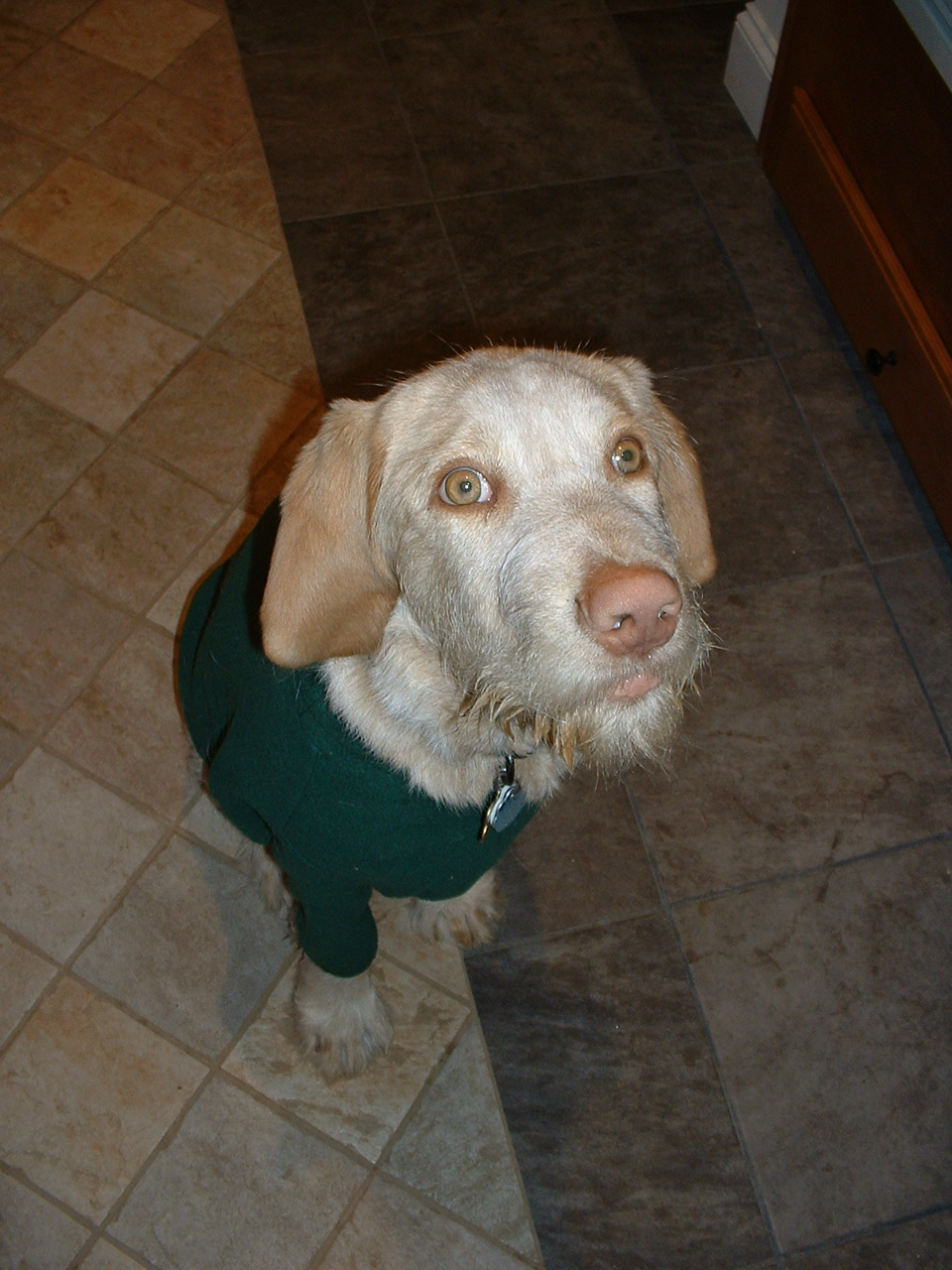
The weekend after Easter I traveled to my parents’ for a sister’s birthday and Percy enjoyed the change of scene, but his appetite did not improve. We returned home and the weather remained relatively mild, but I kept him in his little polartec coat outside as his weight loss left him shivering. By Tuesday, though, he was spending most of his time outside curled up in a tight ball, and for some reason he seemed to seek out the chilly, shady areas, and he was going off by himself. There was no doubt what was happening. I took him to the clinic for a final round of bloodwork on Wednesday, just to confirm.

Thursday April 15 was a pretty spring day that we spent mostly outside in the sun; my son was able to get home from college that afternoon, and our vet came in the evening to euthanize Percy, who lay in one of his favorite spots, on top of the big ottoman in the kitchen. He used to lie there and keep an eye on me as I made dinner. His beautiful eyes flickered open and closed after the first injection, but then he was as if sleeping; he died so quickly and without a movement or sound that it seemed he was just waiting to go, perhaps to know that it was ok.

I had told him that day what was happening and let him know that he would be ok, and so would we. He had lost about 5 pounds the last ten days and seemed so small and skinny, and as heartbroken as I was, I could only be glad he was not suffering anymore. From 3 1/2 months to 10 1/2 months, he had been sick, and we knew he would not live very long. But though it was all too short and marked by illness and seizures, Percy seemed to enjoy his life. And he was loved.

April 14: BUN 208, creatinine 6.8, phosphorus 13.5
February – March 2010

February into March was a good period for Percy. He maintained his weight and due to the phenobarbital would have eaten as much as I would give him, if his kidneys could have processed it. This was hard: I wanted to feed him to fatten him up, knowing the day would come when he would not want to eat so much. But that would have been too much for his kidneys.

The seizures were fairly controlled with the phenobarbital: Percy made it from January 28 to February 9 without a seizure, and then oddly had one every Monday for the next four weeks. The seizures were less severe– they did not last as long, he did not pee or try to get up afterwards. Most were in the middle of the night, but  were now less disruptive to sleep.

a few hours afters after a seizure

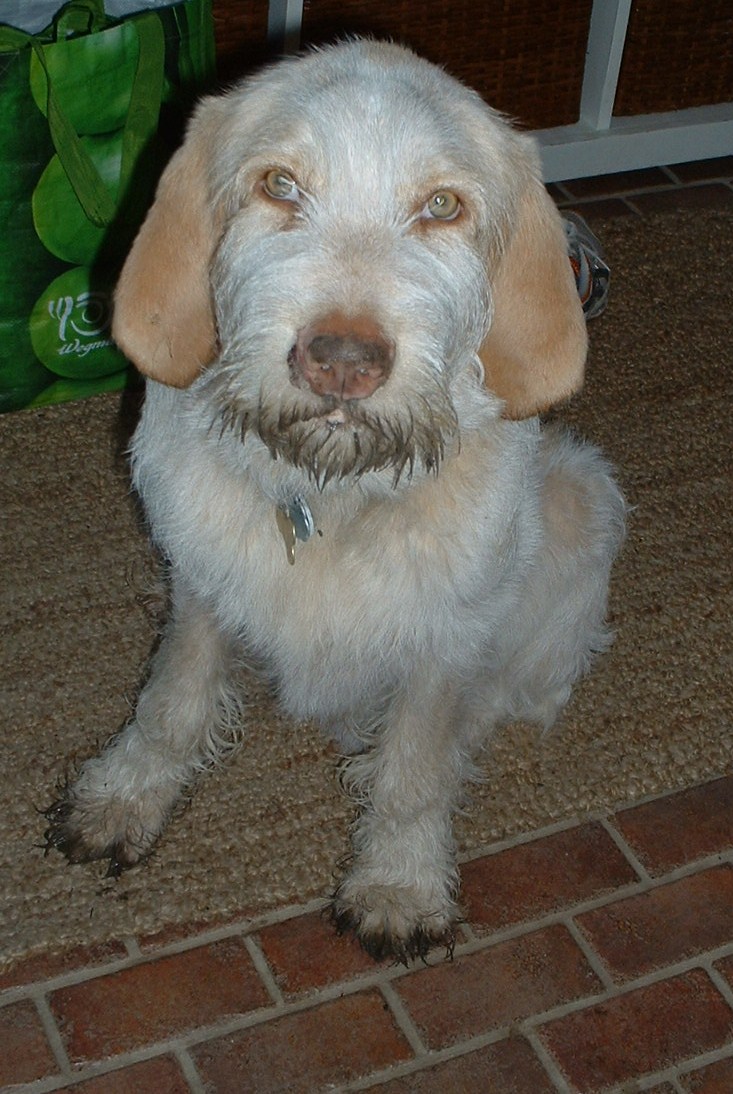
Percy was nearly crazed for food from the phenobarbital and he would jump up and do all sorts of normally unacceptable things for a puppy training to be a dog! But it was hard if not impossible to discipline him in any way, as I knew he would most likely never make it to becoming a grown dog. Though I did come close to losing my temper once, when one evening, just back from an out of town trip,  I’d fed the dogs and we  headed out in the yard for some exercise. I did not pull the door shut tight behind me, and Percy had snuck in and I’m sure headed straight for my takeout, an enormous Caesar salad that I had just begun to eat before we went out. When I realized I had not seen Percy for a few minutes, I guessed where he was, and sure enough I found the door pushed open–this became a habit, and almost a game, as Percy would let himself in to look for food, like a kid raiding the cookie jar when Mom is away, though I usually was more careful not to leave things out. Sometimes I would come in to find him snooping about and he would look at me somewhat sheepishly. This time I found Percy on his hind legs, front paws on the counter with his nose in the salad, what little was left of it, eating away quite neatly from the plate. Into his crate he went, Caesar dressing clinging to his beard.

It was early in February that I realized Percy had what seemed to be large bumps growing up from underneath on either side of his nose. Looking in his mouth, I was horrified to see what looked like huge boil-cysts, the size of a golf ball, almost, on his upper gums, one on each side. They did not prevent him from eating lustily, but he was now less inclined to chew very hard things. They seemed to look much worse than their effect on Percy. Our regular vet was at a loss as to what they might be, suspecting some other developmental issue; the holistic vet drew a sample of fluid from them, both to send it out as well as to try to drain the growth, but it filled up again almost immediately. The lab that analyzed the sample had not seen anything of this nature, the cytologist there described it as fluid containing “refractile calcified debris (..) consistent with dystrophic calcification as is frequently observed in chronic inflammatory, cystic or necrotic lesions.” I only recently learned that oral ulcers are in fact one of the many possible symptoms of chronic renal failure.

February 12 BUN 129, creatinine 6.0, phosphorus 12.7

March 15 BUN 118, creatinine 5.6, phosphorus 9.2

While BUN and phosphorus would fluctuate slightly, one month being higher, another lower, Percy’s creatinine slowly rose through these months; it was 3.3 in September. March showed the only slight drop in the progression.