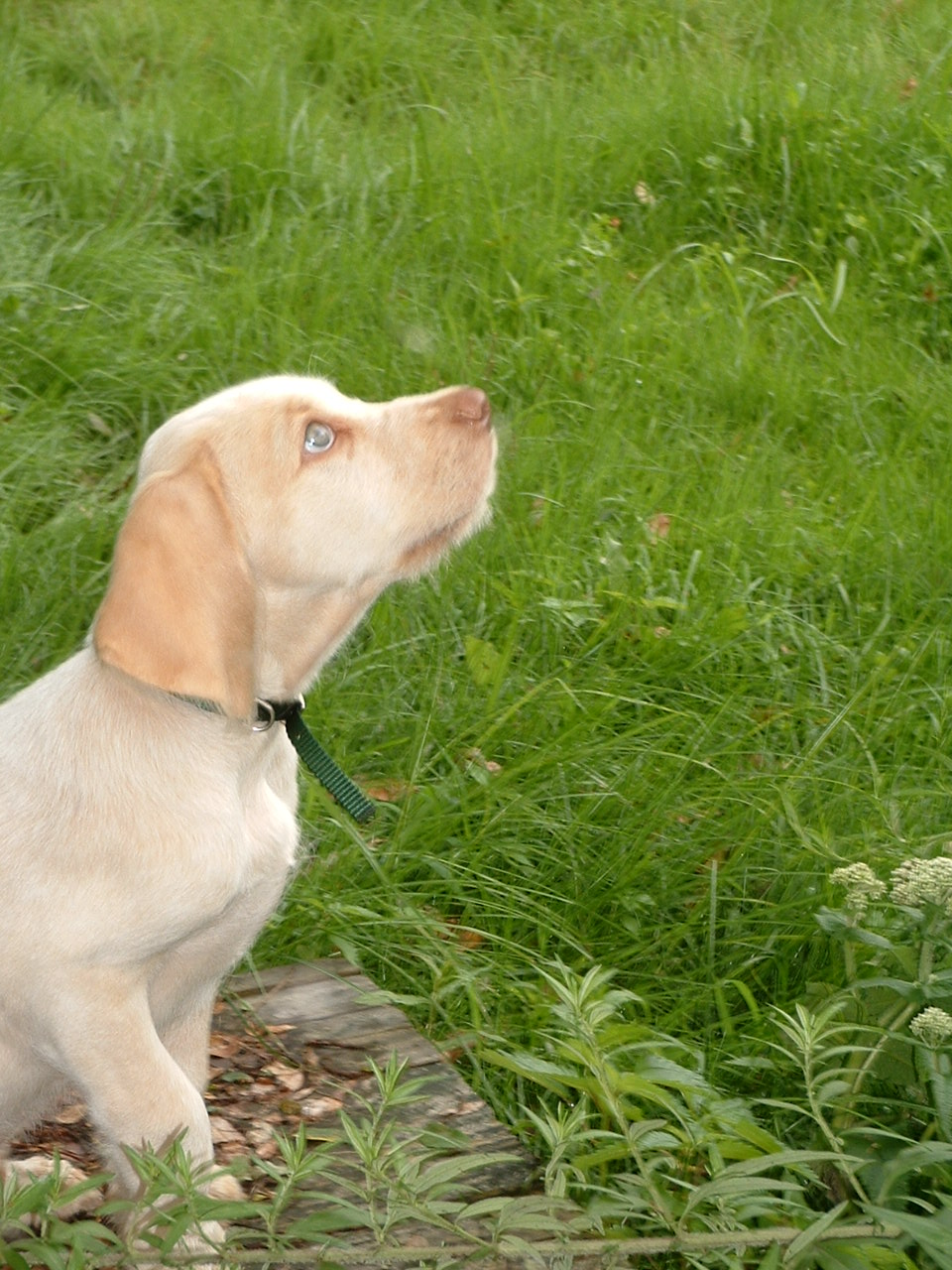
It was just over a year ago, December 2009, that Percy began to get much worse. His seizures were accelerating– from once every few weeks, just before Christmas they began to occur several times a week, eventually accelerating to more than one a day. They increasingly left him weak, tired, and disoriented, beyond what the dysplasia was doing to him. He was not yet seven months old; at not quite 50 lbs., he remained much smaller than his littermates who had mostly all passed 70 by the new year. With the diagnosis in October I knew his life was surely limited but the reality of it did not sink in until he began to seem truly ill. But, let me go back to the beginning.
Percy seemed like a normal, active, happy, adorable puppy when he came home end July 2009. He joined our older Spinone Nocci, then five, who did not know what to make of this whirling dervish. We had lost Fermat eight months earlier; Nocci had known and looked to Fermat from the day he himself came home as a very young pup. I was not sure if we were quite ready for a new furry family member but there was a litter from a highly respected breeder not too far away, and so I took the plunge.
The first weeks were typical seeming new puppy weeks. Percy may have been drinking a little more than what would be considered normal, but it was summer, hot, and it was not enough to stand out. He house trained on schedule– our dogs have all been trained by about four months and Percy was no exception. Excessive drinking and accidents are sometimes first indications of renal dysplasia, as well as lower activity levels, but through August I did not see anything out of the ordinary. We moved towards the end of that month and settled into our new house early in September. It was a happy time, and Nocci was beginning to see that Percy was actually a dog with whom he could scamper and wrestle.The weather was lovely and they spent a lot of time outdoors. Percy had an endearing way of running at top speed as soon as he caught sight of me coming out of the house or around the corner, from wherever he was in the yard– sometimes at a pretty great distance for a small pup– ears flapping and legs a-kilter, down hill or up. When it was down hill, he sometimes got carried away in his enthusiasm and legs unable to keep up with desire to reach me he ended tumbling in a comic puppy somersault. He also would keep close at my heels as we did the perimeter walk to check the fence or pick up poo, and when I was wearing my tall boots he would nip at the buckles as I walked– he was so quiet coming up behind me I often didn’t know he was there until I felt this tug at the top of my boots.
Early in the evening of September 15 Percy had his first seizure. I would eventually keep track of dates and times of all his seizures as if to make sense or try to control the uncontrollable. He was three and a half months old, and he went from sweetly napping just before suppertime to emitting an unearthly involuntary howl, his body contorting, stiffening and shaking, his head rattling with his little jaw clenched. I knelt over him, terrified. Fermat had had a series of epileptic-like seizures in the days before he died, and so seeing Percy in a similar state not only brought back the memory of Fermat dying but also made me think, illogically perhaps, that Percy too could be dying. The vet on call for our local practice told me that epilepsy could indeed appear in dogs so young but that it was unusual, and so doing some bloodwork to see what was happening would be a good idea. I had to travel for work the next day and had someone come to stay with the dogs, fearful that Percy would have another seizure in my absence and die. So it was the following day that I took Percy in to draw blood. Saturday the 19th was Spinoni Day, hosted by the breeders up in the Adirondacks, and we brought Percy and Nocci up to join dozens of other Spinoni, including nine of Percy’s littermates who were able to travel back, and other breeds, on a perfect nearly-autumn day.
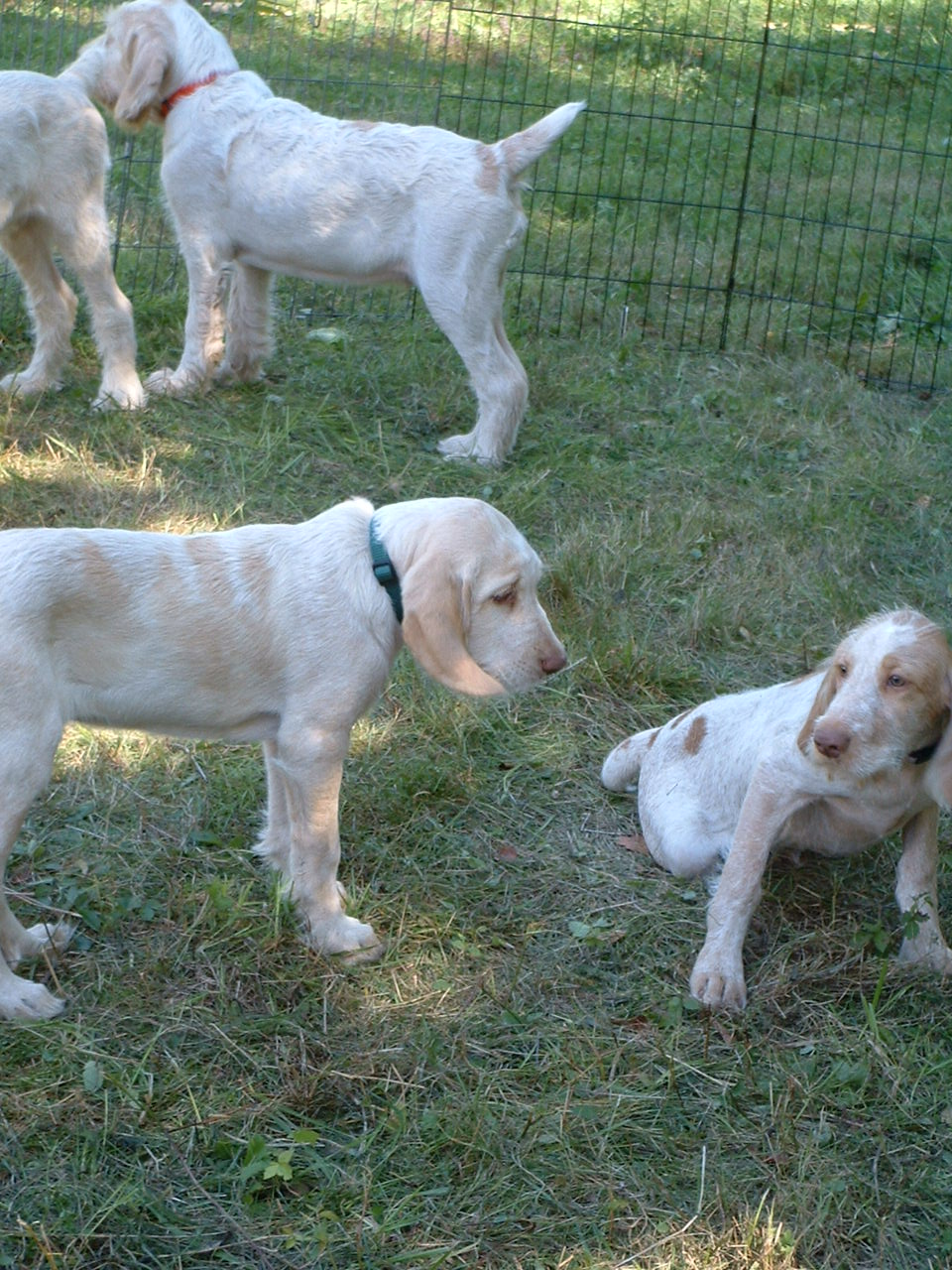
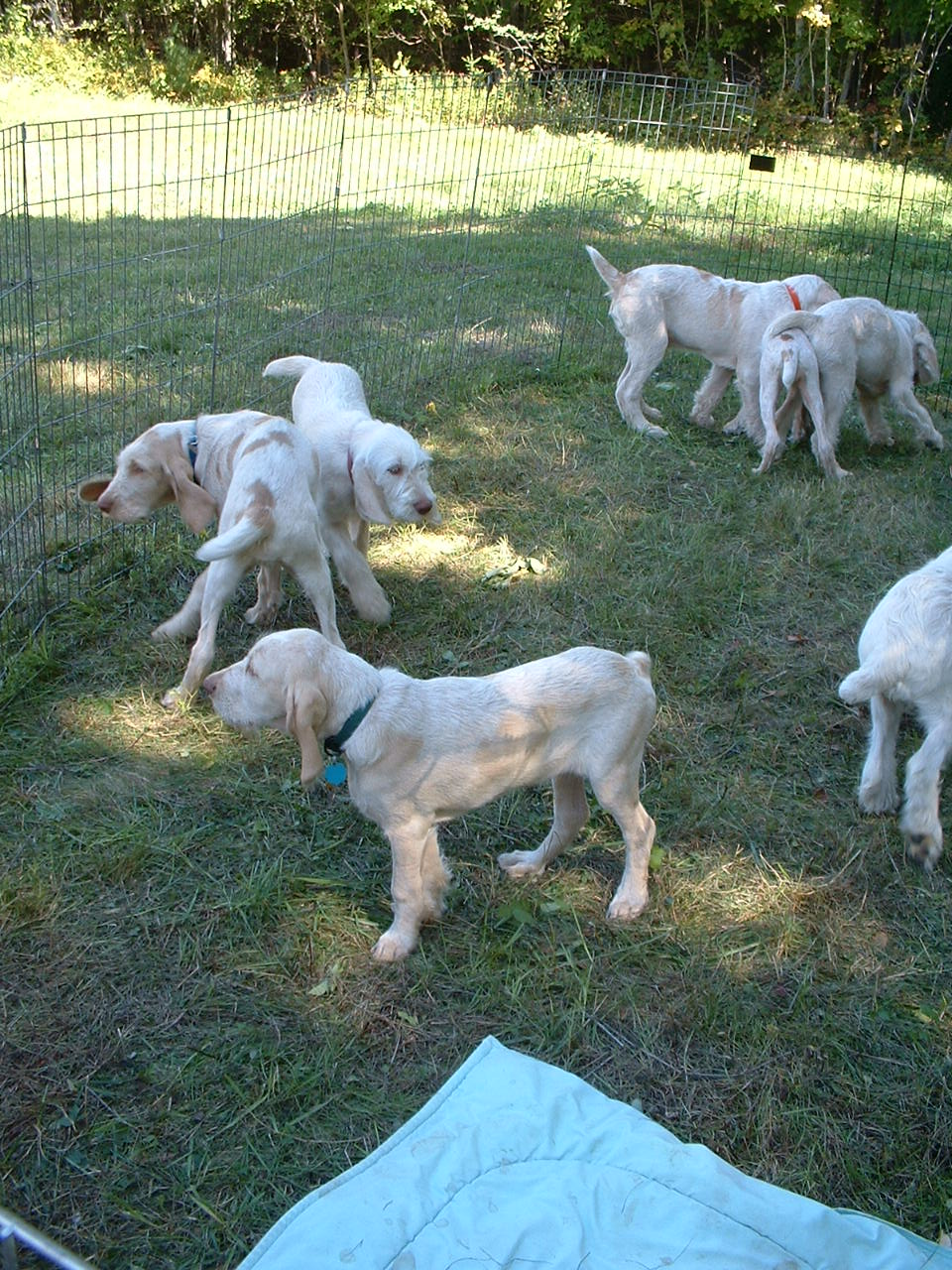
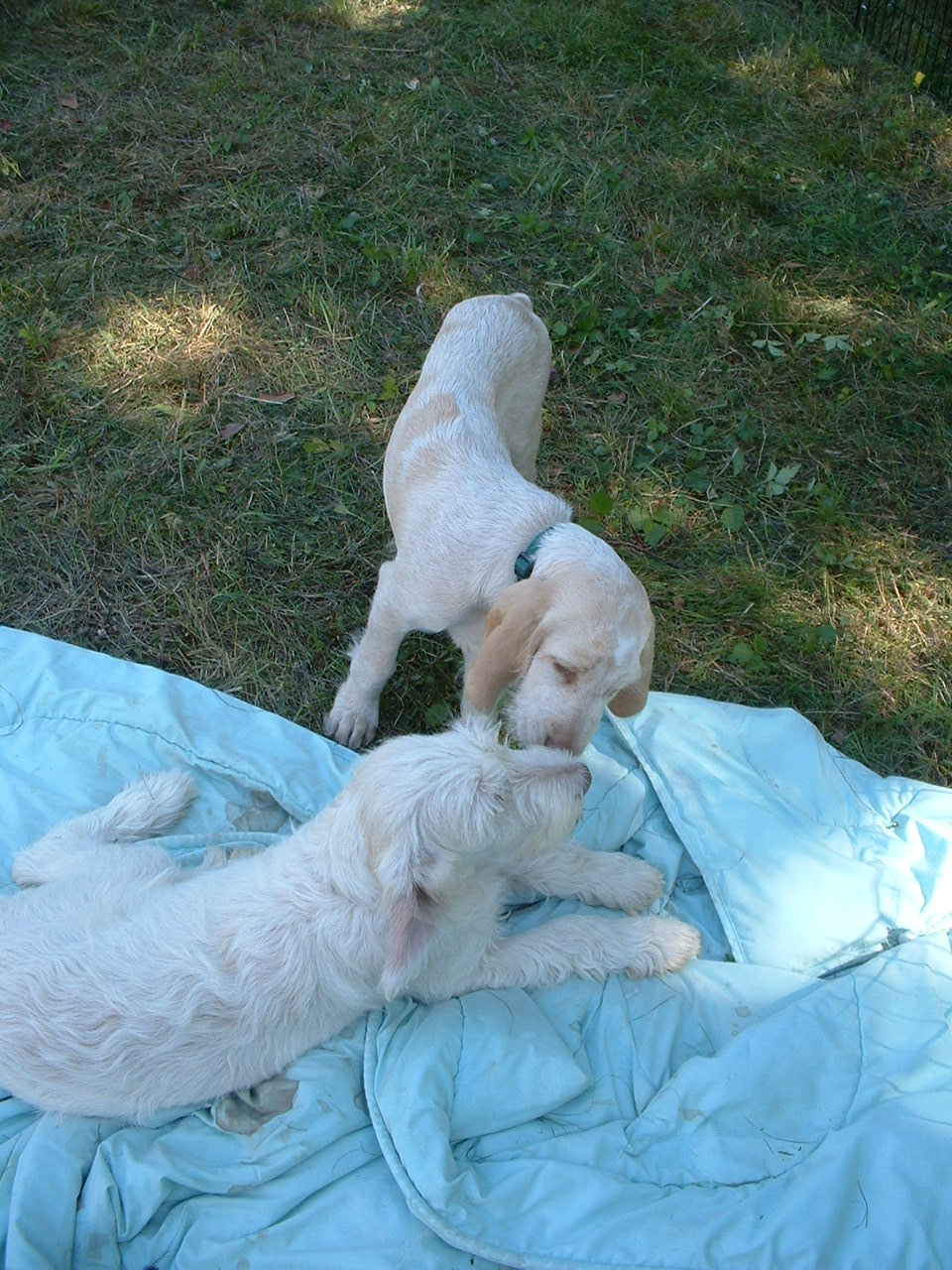
At that point, Percy had had just the one seizure; the breeders thought it could have been caused by the rabies vaccine he had the week prior– his mother had had a reaction to her rabies vaccine even at an older age. Watching him that day with his littermates and all the human attention, he seemed fine, though he did not want to be separated from me for very long. A big pen was set up for all the pups who were happy to loll with each other there, but Percy after some interaction seemed to look for me to take him out (below, Percy is pup with green collar).
On my way home late that afternoon I saw there was a message from our vet and it did not sound good. Speaking with him that evening he told me Percy’s bloodwork showed highly abnormal kidney functions, to a degree indicating an underlying abnormality. For me that is where one story ends and another begins.