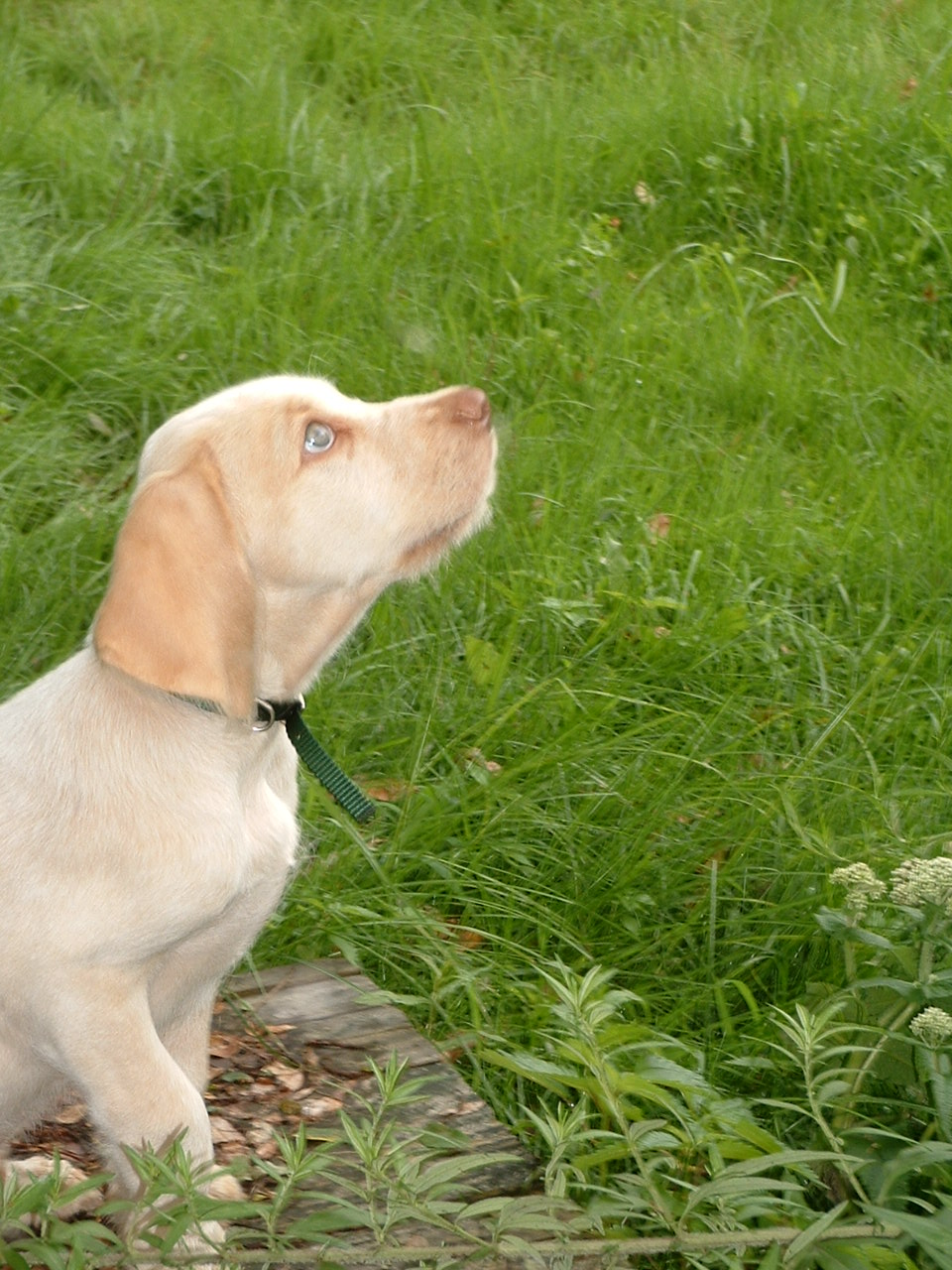
After Percy, April-May 2010

To say I was sad in the face of Percy’s death is a gross understatement. I think in some ways I will never entirely get over losing such a young, sweet animal to such a disease. The sorrow of losing an older, beloved dog is its own kind of hard grief, but the loss of Percy was peculiarly difficult in ways I am still coming to grips with. Every time I see a very young animal I think of him, gangly legs and sweetness of being.

The evening of April 15 the vet took Percy’s body to biopsy the kidneys and send the tissue to Cornell for analysis. He told me  that Percy’s kidneys were so small, they were difficult to locate: they were smaller than those of a good size cat, and Percy even after his loss of weight was four times the size of a cat.

Though for some in the face of such loss no further information is needed or wanted, I wanted as much information as I could gather about what had killed Percy. He was dead and nothing could bring him back to life, but the grueling experience of seeing what he went through when he was alive, and that there was nothing we could do to make him whole and healthy, propelled me to find out whatever we could.

The histopathology report was clear:

“The histologic lesions in both kidneys are consistent with a diagnosis of renal dysplasia. Renal dysplasia in dogs is often hereditary. The immature glomeruli, primitive mesenchyme and presence of primitive (metanephric) ducts are abnormal in an 11-month-old dog and diagnostic for renal dysplasia.”

Read the entire report by clicking the image, above.

Ideally, neither Percy’s sire or dam should have been bred again, as although at present no definitive diagnosis is possible for this breed and this disease (see Links for information on canine genetic studies at Harvard/MIT’s Broad Institute), Percy’s clinical presentation and the histopathology report leave little doubt that he suffered from juvenile renal dysplasia; we know that JRD is “often hereditary.”

The breeders focused on a genetic test we did in January 2010 with Dogenes, a Canadian lab that conducts canine genetic testing. We sent samples for Percy and for both the sire and dam; the results indicated that both parents were carriers and that Percy was affected, with a homozygous mutant allele.  However, within a few months the breeders told me they viewed the lab to be largely discredited, at least anecdotally, in terms of tests done with other breeds. Due to the uncertainty surrounding the validity of the test and possibly the lab itself,  I do not mention this testing elsewhere on Percy’s Page or in any way use the findings of the Dogenes test to support the diagnosis for Percy. This is also out of respect for the breeders, whom I generally believe have the best interest of the breed at heart.

I lost track of the Dogenes story, as it did not mean much to me in terms of knowing what killed Percy, but the breeders held fast to it and amassed details about the failings, in their eyes, of the lab and its director; they interpreted the lack of 100% certainty around this one genetic test to mean that the dogs were unlikely to be affected genetically, and that what happened to Percy was just bad luck, a bad twist of nature. The dam has since been bred again.

In the absence of a definitive genetic test, the facts remain the same. Percy presented clinically for JRD from the age of 3 1/2 months, the ultrasound suggested as much, and the gross autopsy and histopathology only further confirmed this. I would not take even a very slight chance that another puppy and owner would go through what he and I went through. And this is why Percy’s Page is here.
 

October 2009: diagnosis

It was the second week of October that he had the ultrasound, and the confirmation of the disease was all too visible on the screen. His kidneys were almost not there: there was water where there should have been mass. Seeing this and hearing it described was like a death sentence being handed to me for my adorable four-month old pup. I remember holding him in my lap and simply trying to hold myself together: I don’t cry in public but I could feel everything retract inside me into a protective mode, protective of him, of me. But there was no protection to be had. He would die from lack of kidneys, and all we could do would be to manage his diet and give him supplements to help what little kidneys he had do the job they were meant to do. It would only buy a little time.

Yet he seemed like a puppy of that age would, playful with a good appetite, eating rabbit droppings in the yard with gusto. He and Nocci could graze for hours on them. Since the second seizure in September there had been no more, so I just sort of held my breath, knowing it was only a matter of time before things started to look worse.

Percy’s initial treatment consisted of a low-protein diet with supplements serving to bind phosphates and reduce blood toxins, as well as additional supplements for general health and to address the ancillary issues affecting him. Please see the treatment posts for details.


November 6 BUN 128, creatinine 3.4, phosphorus 11.2. In addition his sodium to potassium ratio had dropped from 27 in September (the low end of normal) to 23, just below normal. As a result the following week we did a test for Cushing’s, just in case, but it was negative.


One number would rise, another would go down, but they did not improve significantly.

Percy’s World

It was just over a year ago, December 2009, that Percy began to get much worse. His seizures were accelerating–  from once every few weeks, just before Christmas they began to occur several times a week, eventually accelerating to more than one a day.  They increasingly left him weak, tired, and disoriented, beyond what the dysplasia was doing to him. He was not yet seven months old; at not quite 50 lbs., he remained much smaller than his littermates who had mostly all passed 70 by the new year. With the diagnosis in October I knew his life was surely limited but the reality of it did not sink in until he began to seem truly ill. But, let me go back to the beginning.

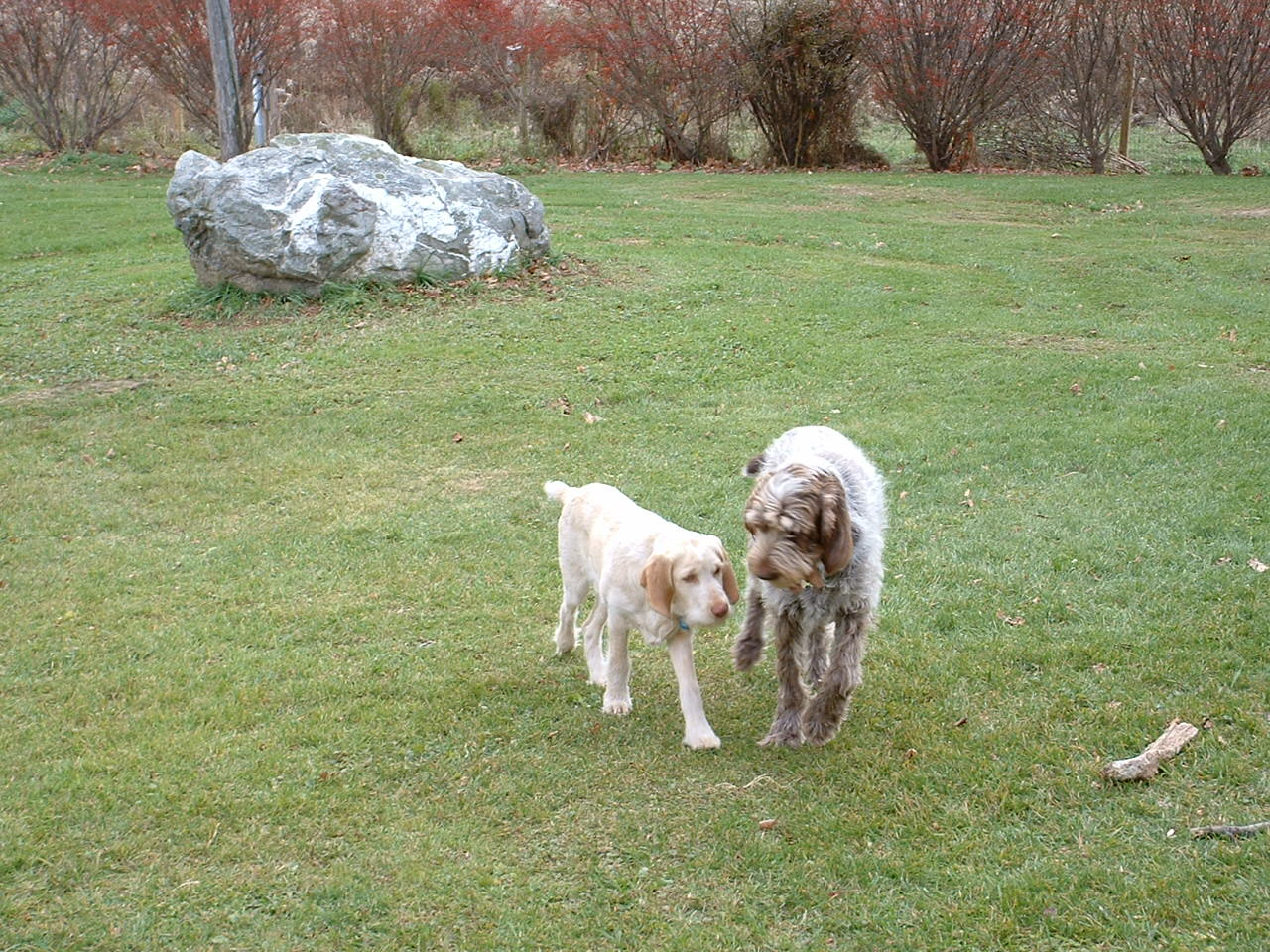
Percy seemed like a normal, active, happy, adorable puppy when he came home end July 2009. He joined our older Spinone Nocci, then five, who did not know what to make of this whirling dervish. We had lost Fermat eight months earlier; Nocci had known and looked to Fermat from the day he himself came home as a very young pup. I was not sure if we were quite ready for a new furry family member but there was a litter from a highly respected breeder not too far away, and so I took the plunge.

The first weeks were typical seeming new puppy weeks. Percy may have been drinking a little more than what would be considered normal, but it was summer, hot, and it was not enough to stand out. He house trained on schedule– our dogs have all been trained by about four months and Percy was no exception. Excessive drinking and accidents are  sometimes first indications of renal dysplasia, as well as lower activity levels, but through August I did not see anything out of the ordinary. We moved towards the end of that month and settled into our new house early in September. It was a happy time, and Nocci was beginning to see that Percy was actually a dog with whom he could scamper and wrestle.The weather was lovely and they spent a lot of time outdoors. Percy had an endearing way of running at top speed as soon as he caught sight of me coming out of the house or around the corner, from wherever he was in the yard– sometimes at a pretty great distance for a small pup– ears flapping and legs a-kilter, down hill or up. When it was down hill, he sometimes got carried away in his enthusiasm and legs unable to keep up with desire to reach me he ended tumbling in a comic puppy somersault. He also would keep close at my heels as we did the perimeter walk to check the fence or pick up poo, and when I was wearing my tall boots he would nip at the buckles as I walked– he was so quiet coming up behind me I often didn’t know he was there until I felt this tug at the top of my boots.

Early in the evening of September 15  Percy had his first seizure. I would eventually keep track of dates and times of all his seizures as if to make sense or try to control the uncontrollable. He was three and a half months old, and he went from sweetly napping just before suppertime to emitting an unearthly involuntary howl, his body contorting, stiffening and shaking, his head rattling with his little jaw clenched. I knelt over him, terrified. Fermat had had a series of epileptic-like seizures in the days before he died, and so seeing Percy in a similar state not only brought back the memory of Fermat dying but also made me think, illogically perhaps, that Percy too could be dying. The vet on call for our local practice told me that epilepsy could indeed appear in dogs so young but that it was unusual, and so doing some bloodwork to see what was happening would be a good idea. I had to travel for work the next day and had someone come to stay with the dogs, fearful that Percy would have another seizure in my absence and die. So it was the following day that I took Percy in to draw blood. Saturday the 19th was Spinoni Day, hosted by the breeders up in the Adirondacks, and we brought Percy and Nocci up to join dozens of other Spinoni, including nine of Percy’s littermates who were able to travel back, and other breeds, on a perfect nearly-autumn day.

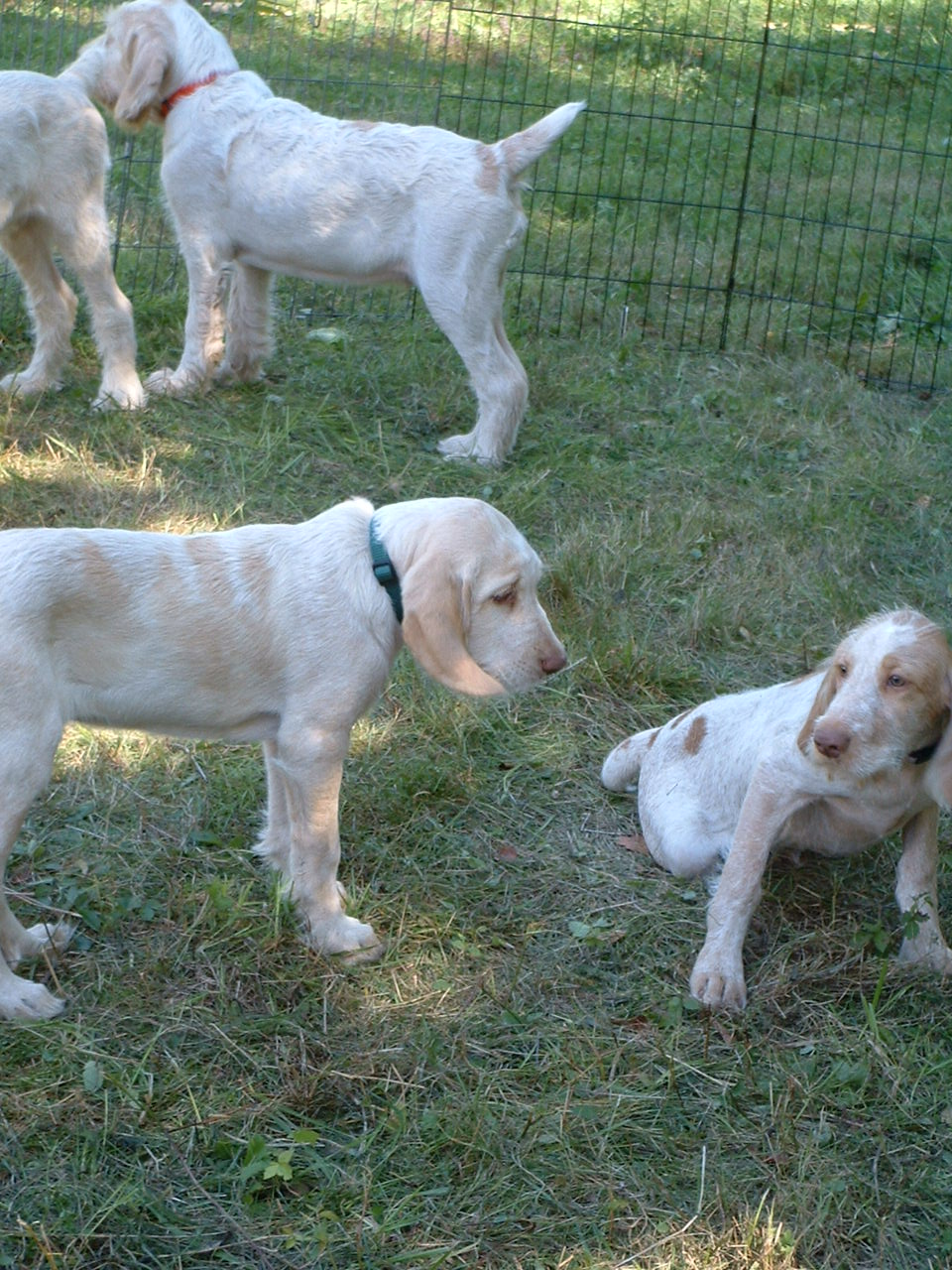
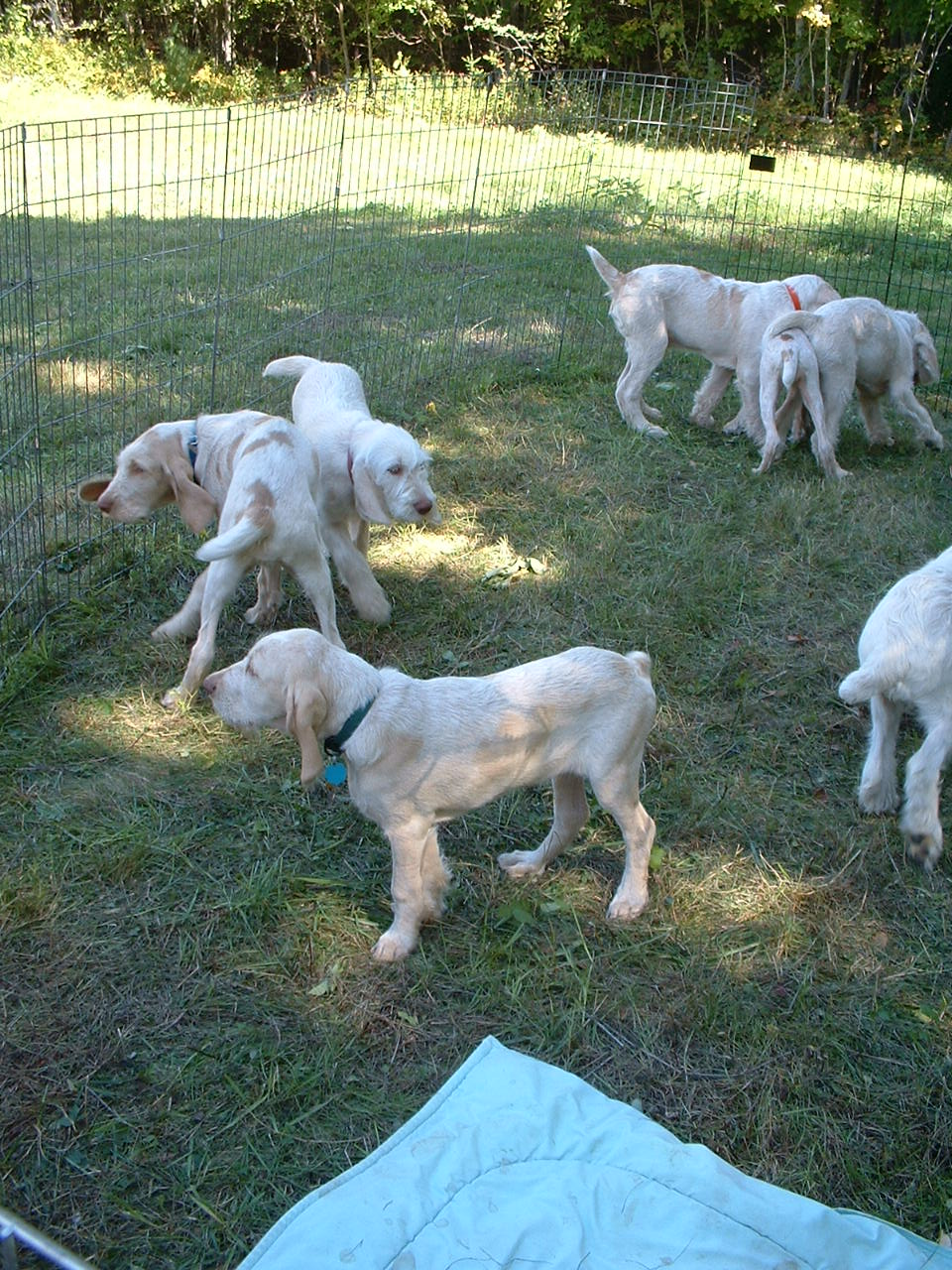
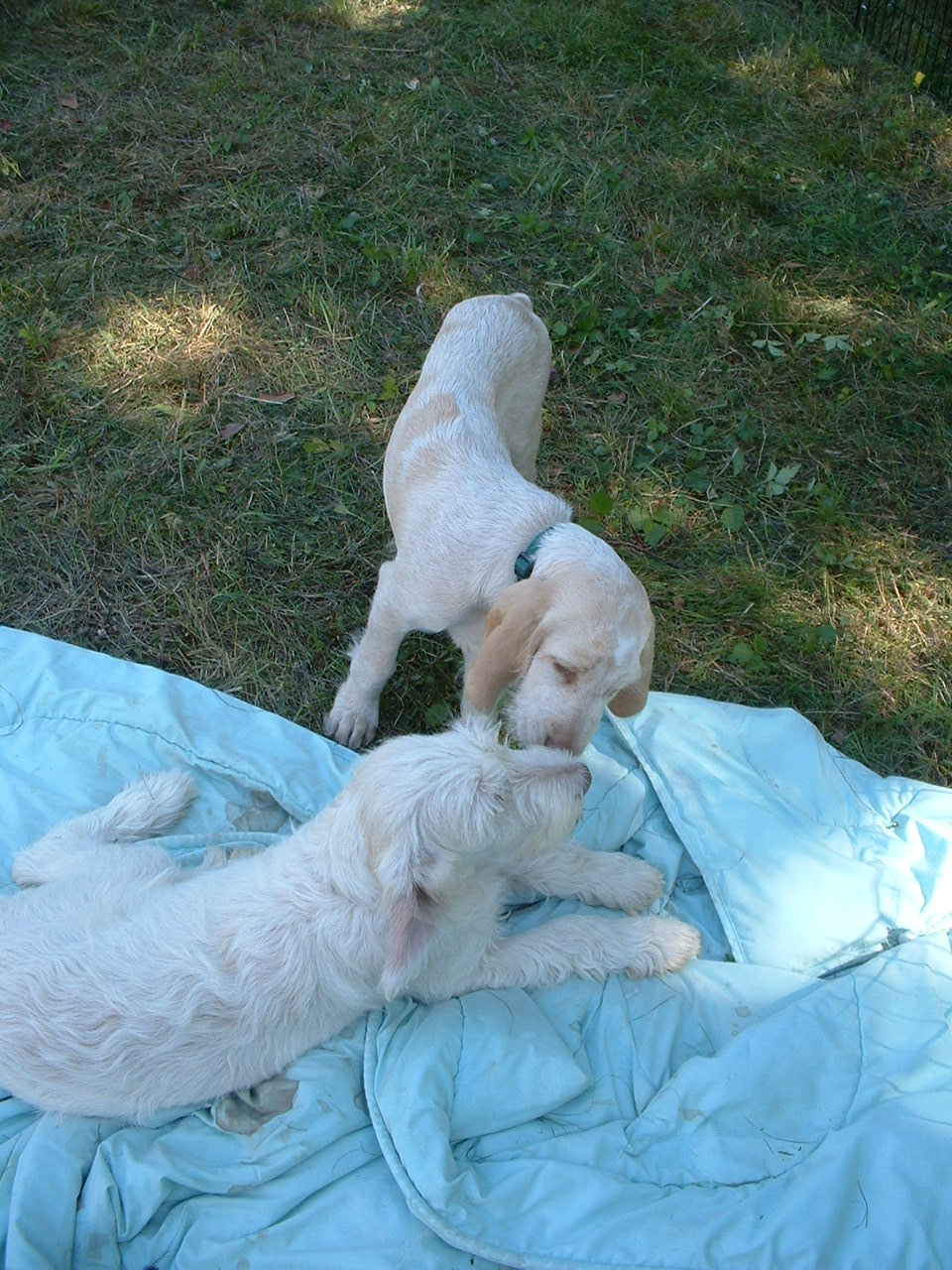
At that point, Percy had had just the one seizure; the breeders thought it could have been caused by the rabies vaccine he had the week prior– his mother had had a reaction to her rabies vaccine even at an older age. Watching him that day with his littermates and all the human attention, he seemed fine, though he did not want to be separated from me for very long. A big pen was set up for all the pups who were happy to loll with each other there, but Percy after some interaction seemed to look for me to take him out (below, Percy is pup with green collar).

On my way home late that afternoon I saw there was a message from our vet and it did not sound good. Speaking with him that evening he told me Percy’s bloodwork showed highly abnormal kidney functions, to a degree indicating an underlying abnormality. For me that is where one story ends and another begins.