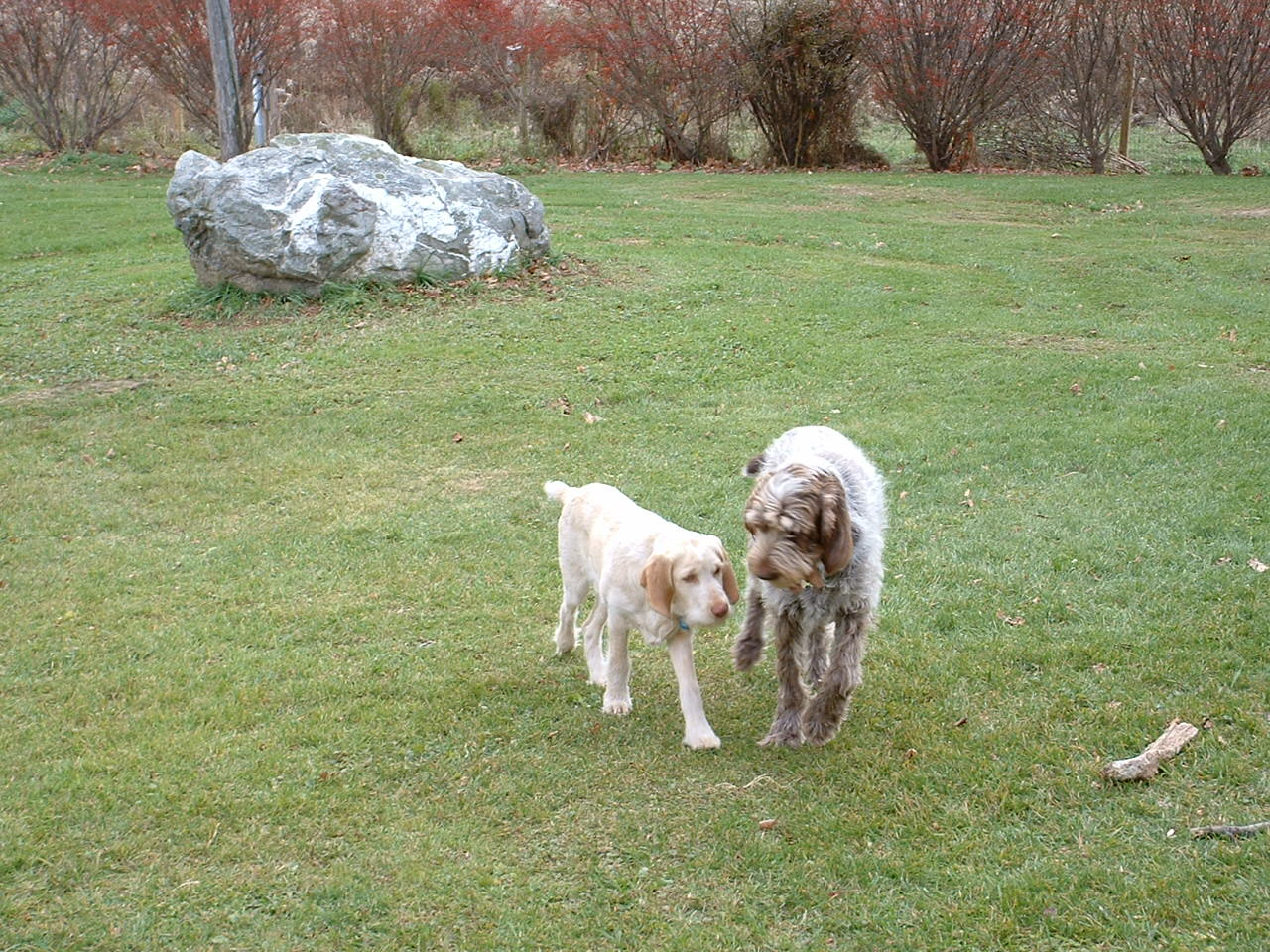
To say I was sad in the face of Percy’s death is a gross understatement. I think in some ways I will never entirely get over losing such a young, sweet animal to such a disease. The sorrow of losing an older, beloved dog is its own kind of hard grief, but the loss of Percy was peculiarly difficult in ways I am still coming to grips with. Every time I see a very young animal I think of him, gangly legs and sweetness of being.
The evening of April 15 the vet took Percy’s body to biopsy the kidneys and send the tissue to Cornell for analysis. He told me that Percy’s kidneys were so small, they were difficult to locate: they were smaller than those of a good size cat, and Percy even after his loss of weight was four times the size of a cat.
Though for some in the face of such loss no further information is needed or wanted, I wanted as much information as I could gather about what had killed Percy. He was dead and nothing could bring him back to life, but the grueling experience of seeing what he went through when he was alive, and that there was nothing we could do to make him whole and healthy, propelled me to find out whatever we could.
The histopathology report was clear:
“The histologic lesions in both kidneys are consistent with a diagnosis of renal dysplasia. Renal dysplasia in dogs is often hereditary. The immature glomeruli, primitive mesenchyme and presence of primitive (metanephric) ducts are abnormal in an 11-month-old dog and diagnostic for renal dysplasia.”
Read the entire report by clicking the image, above.
Ideally, neither Percy’s sire or dam should have been bred again, as although at present no definitive diagnosis is possible for this breed and this disease (see Links for information on canine genetic studies at Harvard/MIT’s Broad Institute), Percy’s clinical presentation and the histopathology report leave little doubt that he suffered from juvenile renal dysplasia; we know that JRD is “often hereditary.”
The breeders focused on a genetic test we did in January 2010 with Dogenes, a Canadian lab that conducts canine genetic testing. We sent samples for Percy and for both the sire and dam; the results indicated that both parents were carriers and that Percy was affected, with a homozygous mutant allele. However, within a few months the breeders told me they viewed the lab to be largely discredited, at least anecdotally, in terms of tests done with other breeds. Due to the uncertainty surrounding the validity of the test and possibly the lab itself, I do not mention this testing elsewhere on Percy’s Page or in any way use the findings of the Dogenes test to support the diagnosis for Percy. This is also out of respect for the breeders, whom I generally believe have the best interest of the breed at heart.
I lost track of the Dogenes story, as it did not mean much to me in terms of knowing what killed Percy, but the breeders held fast to it and amassed details about the failings, in their eyes, of the lab and its director; they interpreted the lack of 100% certainty around this one genetic test to mean that the dogs were unlikely to be affected genetically, and that what happened to Percy was just bad luck, a bad twist of nature. The dam has since been bred again.
In the absence of a definitive genetic test, the facts remain the same. Percy presented clinically for JRD from the age of 3 1/2 months, the ultrasound suggested as much, and the gross autopsy and histopathology only further confirmed this. I would not take even a very slight chance that another puppy and owner would go through what he and I went through. And this is why Percy’s Page is here.